
February 23, 2026
Executive Summary
- Market Inflection Point - European electricity markets are at a critical juncture for US Fortune 500 VPPA buyers. Wind and solar surpassed fossil fuels for the first time in 2025 (30% vs. 29% of EU power), yet EU wholesale prices remain well above US levels. This duality - accelerating renewable supply amid structurally elevated prices - creates a favorable but complex window for corporate VPPA procurement across AIB markets.
- Supply-Side Dynamics Driving Opportunity - Top quartile solar PPA prices in active markets declined as demand for renewables decreased. Record solar deployment (369 TWh, +20% YoY) is depressing capture rates in saturated markets. Germany's solar capture rate fell to approximately 53% and Spain's to approximately 49% in early 2025, creating a buyer's market where top-quartile solar VPPA prices declined to €54.63/MWh in Q4. Wind VPPAs, though less available, are not as impacted by lower daytime capture rates and show stronger economics with positive modeled returns in 3 of 4 active wind markets.
- Moderate Demand-Side Tailwinds - EU electricity demand is forecast to grow 1.5% in 2026 and approximately 2.3% annually through 2030, driven by data center expansion (750 MW of new capacity in 2026), EV adoption, heat pump installations, and industrial re-electrification. The Russian LNG phase-out (spot ban in January 2026; long-term contracts by 2027) keeps gas-linked wholesale prices volatile, strengthening the hedge value of fixed-price VPPAs for US corporations with European Scope 2 exposure.
- Regulatory Change - Regulatory changes including a new EU Grid Package which encourages investment in grid infrastructure; Renewable Energy Directive (RED) III raising EU’s renewable energy ambitions; and a phase-out of Russian natural gas, signal progress towards a more sustainable European energy market.
- Key Risks for Corporate Buyers - Cross-border price volatility is eroding hedging confidence in pan-European VPPAs as VPPA settlement prices diverge from physical consumption costs in other markets. Solar cannibalization threatens long-term returns in Spain and Germany. Uneven RED III transposition across 8+ member states creates permitting and GO delivery uncertainty. Mitigation strategies increasingly include hybrid solar+BESS structures, wind diversification, and domestic (versus cross-border) VPPA sourcing. Battery energy storage systems (BESS) continues to accelerate, especially in countries with high solar penetration like Germany, and some key contracting structures to include a battery in a VPPA are highlighted in this Opportunity Index.
- Strategic Implication - The convergence of falling VPPA offer prices, regulatory tailwinds (RED III, EU Grid Package), and rising wholesale price floors creates a compelling but time-sensitive procurement window. Our Q4 2025 Opportunity Index financial projections, which take into account the above supply and demand dynamics, show strong VPPA opportunities in select markets from the best offers from highly competitive RFPs (NZCB received over 500 proposals in our last RFP). The Opportunity Index suggests that corporates should prioritize wind VPPAs in Portugal and Finland for strongest cash flows, solar in Greece and Spain for positive returns, and evaluate BESS-paired contracts to mitigate cannibalization risk in select markets, most notably Germany.
Introduction
This installment focuses on Q4 2025 before the 2026 conflict in Iran, which we will be analyzing in our 2026 Q1 update coming out in May.
The NZCB European Opportunity Index informs corporate renewable energy buyers interested in procuring clean energy in Europe. It provides an overview of PPA trends, key regulatory changes, BESS trends, and solar and wind forward pricing by active country.
PPA Price Trend
In Q4 2025, SR Inc partner LevelTen Energy’s offer volumes dropped, which often happens at the end of the fiscal year as developers focus on fulfilling existing offers. While offer volume declined, so did the P25 pricing offers across active countries (weighting the average price in each country equally), where NZCB found that prices decreased from €58.39 in Q3 to €54.63 in Q4. This is primarily driven by select markets experiencing greater levels of solar cannibalization, which erodes modeled returns and drives developers to reduce PPA prices. This impact was experienced most notably in Germany and Spain, resulting in lessened contract values that compelled developers to reduce prices as they acknowledge these market realities in this buyer-favorable market for clean energy VPPAs in Europe.
Supply: Renewables Ascendant, Grid Strained
Wind and solar reached 30% of EU electricity in 2025, exceeding fossil fuels (29%) for the first time on record. Solar alone hit a record 369 TWh (+20% YoY), surpassing both coal and hydro individually. However, 1,700 GW of renewable projects are stuck in connection queues across 16 European nations, with 72 TWh curtailed due to grid bottlenecks. Permitting timelines of up to 9 years continue to constrain new supply. Gas generation rose 8% in 2025 as hydro fell 12% and wind declined 2%, pushing the EU power sector's gas import bill to €32 billion (+16% YoY) and reinforcing wholesale price volatility. Negative pricing hours reached 6% in France, Germany, the Netherlands, and Spain; doubling in Spain year-over-year-signaling structural oversupply during peak solar hours and strengthening the case for accelerated battery deployment in those markets.
Demand: Moderate Growth, Structural Shifts
Europe’s electricity demand rose 1.1% year over year in 2025, as manufacturing continues to recover from the energy price shock of 2021-2022 and industrial electricity prices remain significantly higher than in other regions of the world. Electricity demand is projected to grow moderately in Europe as AI demand from data centers drives load in the continent and industry regains traction.
In 2026, data center vacancies are projected to reduce to historical lows, as 750 MW of data center capacity is expected to be installed, which is the equivalent of all of France’s 2025 colocated data center capacity. Short-term availability will be valued at a premium, as data centers fight for space in a saturating demand market. While they are currently heavily concentrated in Germany, the UK, the Netherlands, France and Ireland; rapid buildout is occurring in the cooler Nordic countries, and land-rich southern ones. In the medium-term, the IEA expects European energy demand to grow on average 2.3% per year until 2030.
Regulatory Tailwinds & Policy Landscape
The EU Grid Package
The non-profit Beyond Fossil Fuels estimated that in 2024, 1,700 GW of renewable energy projects across 16 European nations were stuck in connection queues. In comparison, Switzerland’s total installed solar capacity in 2024 was 8 GW. Additionally, Aurora Energy Research estimated that there were 72 TWh of grid curtailment the same year due to grid bottlenecks. Proportionally, Switzerland’s 2024 total electricity consumption was about 58 TWh. As new generation capacity comes online, Europe is facing hurdles with meeting this pipeline with the required interconnection infrastructure. Renewable energy projects across Europe can take up to nine years to obtain necessary permitting which slows down development and increases costs. The European Union is tackling this issue through its EU Grid Package, which was presented to the Commission in December 2025, and is likely to be decided upon in late 2026 or early 2027. It aims to increase investment in transmission and distribution networks. New-build projects with CODs in 2028 or later could benefit from this new policy.
The Grid Connection Guidance is one of the key elements of the Grid Package. It highlights the need for grid transparency, digitalization, and flexibility across voltage levels, placing an emphasis on hybrid and storage projects. It strives to speed up the interconnection process by moving towards a “first ready, first served” queue rather than “first come, first served.” It also offers a flexible connection agreement structure to allow asset owners remuneration for ceasing to discharge when there is grid congestion. The grid package will also streamline the permitting process by asking Member States to create a single digital portal through which permitting can be approved for grid projects, storage, and renewable assets.
Renewable Energy Directive III (RED III)
The Renewable Energy Directive III (Directive EU 2023/2413) entered into force in November 2023 and is the EU's primary legislative framework for renewable energy deployment. It raises the bloc's binding renewable energy target to 42.5% of gross final energy consumption by 2030, up from 32% under RED II. Importantly for corporate buyers, RED III formally recognizes PPAs and VPPAs as key instruments for renewable deployment and requires Member States to identify and remove barriers to PPA execution. It also mandates that Guarantees of Origin (GOs) be transferable to PPA buyers regardless of whether the underlying project receives state support, closing a longstanding gap that had complicated renewable energy claims under frameworks like the CSRD. A further notable provision requires Member States to designate renewable energy "acceleration areas" where streamlined permitting applies, which should gradually expand the developable project pipeline across Europe.
However, the implementation of RED III has been significantly delayed. The primary national implementation deadline was May 2025, with certain permitting provisions due as early as July 2024. In December 2025, the European Commission escalated infringement proceedings, issuing formal opinions to Greece, France, Italy, Cyprus, Hungary, Malta, Poland, and Portugal for failing to fully transpose the directive. For corporate renewable energy buyers, this uneven implementation creates variability across PPA markets. In countries facing infringement proceedings, particularly France, Italy, and Poland, permitting timelines may remain extended and GO transferability less certain, adding delivery and counterparty risk to PPA structures. Buyers procuring in these markets should ensure contracts include robust GO delivery obligations. In markets that have moved swiftly on transposition, the acceleration area framework should improve project pipeline and buyer optionality over the medium term.
Russian LNG and Pipeline Gas Phase-Out
In 2025, Europe’s power sector experienced significant reductions in overall fossil fuel based pricing reliance with record solar growth compensating for significant reductions in wind and hydroelectric generation, due to wind drought and low rainfall. The percent of hours where natural gas determined electricity prices was down from 74% in 2021 to 32% in 2025, indicating a shifting paradigm in the pricing of European electricity.
However, the gas-to-power ratio, indicating more natural gas used per unit of electricity production, increased by 11% due to demand from extreme cold events in the winter of Q1 2025. OECD Europe’s 2025 natural gas usage increased by 3% in total, the steepest rise since 2021, though this increase was concentrated in Q1 and remained flat throughout the rest of the year. Overall gas usage is expected to decrease in 2026 as natural gas prices rise and the European grid moves away from fossil fuels.
This can partially be attributed to the European Parliament’s decision in December 2025 to phase out Russian liquid natural gas (LNG) imports. This regulation was formally implemented in January 2026 and contains a staggered timeline for the prohibition of Russian natural gas on the spot market. Meanwhile, long-term contracts are prohibited starting in January 2027 and pipeline imports under these contracts are disallowed after September 2027. While existing sanctions (which needed bi-yearly unanimous reapprovals) had similar effects of limiting Russian LNG imports, this is a more long-term solution that allows energy players to plan accordingly and requires states to submit natural gas diversification plans. Overall, this pushes Europe towards a more sustainable grid.
For corporate renewable energy buyers, Europe's continued dependence on imported gas, now increasingly LNG rather than Russian pipeline gas, keeps electricity prices structurally elevated and volatile. EU gas supply infrastructure is set to significantly exceed demand by 2030, representing costly overinvestment rather than supply restriction. This elevated price environment strengthens the case for locking in long-term renewable supply through VPPAs, which become buyer-favorable when market electricity prices rise above the contracted strike price. The cost of fully phasing out Russian gas varies across scenarios, but the direction is clear: LNG-dependent electricity pricing creates ongoing exposure to global commodity volatility against which renewable procurement directly hedges.
Battery Energy Storage Systems (BESS)
BESS Contracting Structures
BESS systems are the future of European renewable energy. Especially in markets where solar cannibalization is ramping up, storage projects are emerging as a critical enabler of Europe's energy transition. As the continent accelerates its renewable buildout, with wind and solar now generating more electricity than fossil fuels for the first time on record, the intermittency of these sources is creating an increasingly urgent need for flexible storage capacity. Solar cannibalization is becoming a structural feature of European power markets rather than an occasional anomaly; negative prices occurred in 3.3% of all hours in 2025, but this percentage was much higher most recently in select markets and battery deployment will directly help mitigate negative pricing.
Without storage to absorb this surplus and dispatch it during evening peak demand or low-wind periods, the value of renewable assets erodes and gas remains the default balancing mechanism. BESS directly addresses this gap: capturing cheap or negatively-priced renewable electricity and releasing it when prices are highest, improving both the economics of renewable generation and the broader stability of the grid. For corporate energy buyers, BESS also introduces new contracting structures that go beyond the traditional VPPA, offering more active control over generation profiles and settlement outcomes.
Common Hybrid Contracting Structures
- In TBx contracts, the "x" denotes the number of charge/discharge cycles per day. Settlement is calculated by ranking the day's hourly prices, averaging the top x hours to form the high leg and the bottom x hours to form the low leg, then comparing that realized spread against the strike. Settlement equals the realized spread minus strike times contract quantity.
- 7x16/Hybrid Floating Blocks create a price “wall” as the floating price for 16 hours of 7 days per week where an agreed-upon price is used as the subtrahend.
- Tolling agreements are where the buyer pays a fixed price and controls the operation and delivery of the asset while keeping revenues.
In Q4 2025, market data suggests that BESS contracts were roughly as common on Virtual PPA procurements as they were on physical PPAs, with the most common being a tolling structure for physical PPAs. For a buyer who wants to actively manage the load distribution profile and generation of the BESS asset, this is a compelling structure, but for those looking to engage in a virtual agreement with little hands-on management of the assets, SR Inc recommends a TBx or 7x16 structure because they require little active management and are settled on a theoretical, pre-determined basis.
BESS Installation Update
In 2025, Germany installed over 728 MW of BESS capacity across more than 90 projects (excluding those smaller than 1 MW). For scale, 700 MW is roughly the size of a large coal plant. While Germany was an AIB leader in BESS in 2025 and installed their largest annual capacity of BESS assets ever, they are expected to continue growing in this market in 2026.
While momentum is growing steadily in the BESS landscape, Germany has also faced some setbacks. Previously, under German § 35 BauGB, which was decided in November 2025, large-scale BESS projects could streamline their permitting with the unconditional preferential treatment for outdoor projects, allowing them to build outdoors without special justification. However, as of December 2025, this has been scaled back and only battery assets that are spatially and functionally connected to a renewable energy generation plant are privileged under new regulation.
SR Inc’s Q4 2025 Financial Evaluation
The NZCB found that solar VPPA offer prices had decreased from €58.39 in Q3 to €54.63 across active countries in Q4, likely due to increased cannibalization in highly saturated solar markets. While there were eight countries with active solar offers in Q4, there were only four with active wind offers, and the average wind VPPA price decreased from €65.91 in Q3 to €65.63 across active countries in Q4.
Using both historical and forecasted data in Q4 2025, SR Inc’s analysis shows that average VPPA settlement prices across active hubs was €52.34/MWh through term for solar and €68.47/MWh for wind (ranging from €36.37/MWh for Spanish solar to €81.41 for Italian wind).
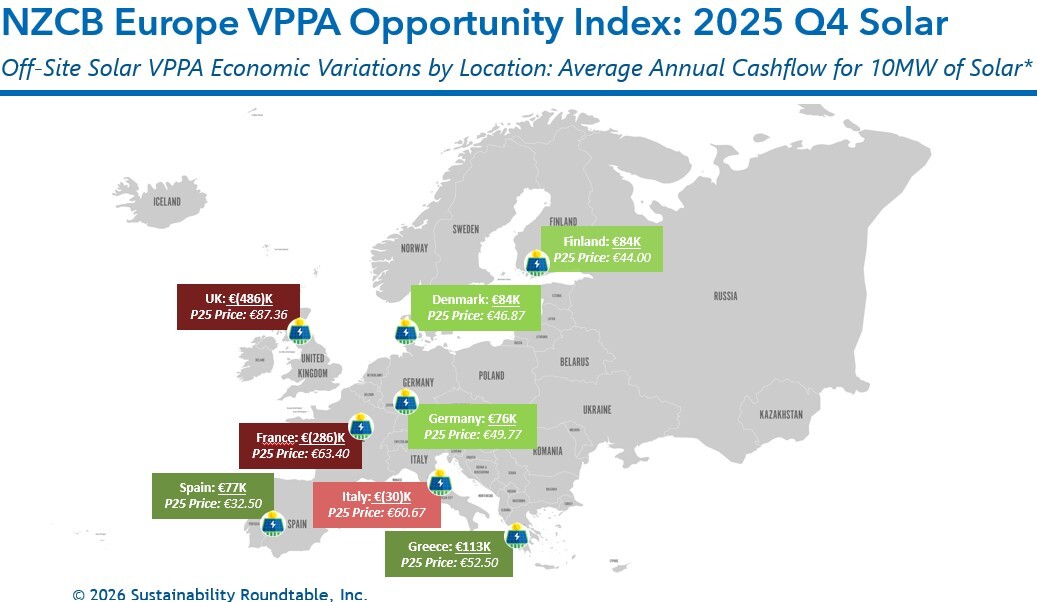
As represented in the graphic below, our analysis shows that Greece and Spanish solar showed the greatest opportunities for positive cashflow in Q4 2025, earning an average annual positive cashflow of €113K and €77K, respectively for a 10 MW offtake. However, the average estimated return on a 10 MW solar offtake across the active European countries was a loss of about €44K per 10MW in Q4.
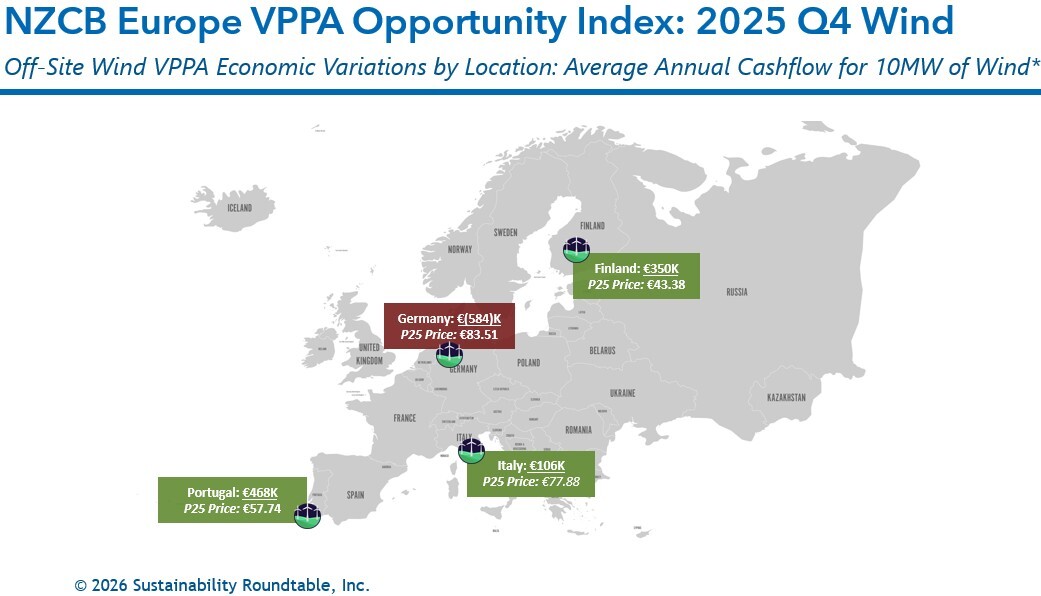
The below graphic shows that the greatest modeled opportunities for positive cashflow for wind VPPAs in Q4 2025 were Portugal and Finland, producing average positive cash flows of €468K and €350K, respectively, for a modeled 10 MW offtake. Wind proposals remained less represented than solar across Europe, but appear to provide a more favorable generation profile than solar on average, as daytime prices are disproportionately impacted by solar deployment, with the return across markets for a 10 MW offtake being a positive €85K.
Methodology
- To calculate average annual cashflows, SR Inc multiplies 1) the difference of historical backcast data and forecasted technology-shaped electricity futures market prices (2027-2041) versus top quartile VPPA prices in each hub by 2) the typical total annual production for 10MW offtakes for wind and solar, respectively.
- SR Inc uses 30K MWh production per year for 10MW of wind in Europe and 20K MWh per year for 10MW of solar in Europe to provide “apples-to-apples” comparisons for both technologies across hubs.
- The top quartile VPPA price typically assumes a scaled offtake of at least 30MW, but SR Inc uses 10MW because it is a typical minimum individual corporate offtake required within aggregated procurements for NZCB participants.
- Our solar analysis is based on LevelTen P25 data from the United Kingdom, Denmark, Finland, Germany, France, Italy, Greece, and Spain.
- Wind analysis includes LevelTen P25 data on Finland, Germany, Italy, and Portugal.
Data Sources
- The NZCB Opportunity Index is developed from proprietary analytics and multiple data providers, which include:
- LevelTen Energy PPA Price Index Europe top quartile VPPA pricing data (all proposed projects of 8+ years)
- LevelTen Energy Marketplace actual average, technology-shaped realized market prices for 2018-2025 (excluding 2022, which stands as an outlier with very high prices due to the war in Ukraine) and the default technology-shaped future market price forecasts for 2027-2041 (as of January 29, 2026).
Glossary
AIB (Association of Issuing Bodies)
The European body that oversees the issuance and tracking of Energy Attribute Certificates (EACs), including Guarantees of Origin (GOs). AIB member registries ensure that renewable energy claims can be verified and traded across borders.
BESS (Battery Energy Storage System)
A technology that stores electrical energy in batteries for later use. In the context of renewable energy procurement, BESS assets can be paired with generation projects to smooth output, capture high-price periods, and improve grid stability.
Cannibalization Effect
The phenomenon where high concentrations of a single generation technology (e.g. solar) in a given market depress electricity prices during peak generation hours, eroding the revenue and modeled returns for new projects of the same type. Particularly pronounced in Spain and Germany for solar.
GO (Guarantee of Origin)
A certificate issued under the European Energy Directive that certifies one MWh of electricity was generated from a renewable source. GOs are the primary instrument used by European corporates to make renewable energy claims.
Gross Final Energy Consumption (GFEC)
The total energy used by end consumers across an economy: covering electricity, heating and cooling, and transport, plus transmission and distribution losses.
PPA (Power Purchase Agreement)
A long-term contract between a renewable energy developer and a buyer for the purchase of electricity at an agreed price. PPAs can be structured as physical delivery or virtual/financial agreements.
VPPA (Virtual Power Purchase Agreement)
A financial contract for renewable energy in which no electricity is physically delivered. Instead, the buyer and developer settle the difference between an agreed strike price and the actual market price at a designated hub. VPPAs allow buyers to support renewable development and make energy attribute claims without taking physical delivery of power.